CO2 laser marking machines use a CO2 gas mixture as the gain medium and emit 10.6 μm (far-infrared) laser light. This wavelength happens to align with the absorption peaks of a wide range of non-metal materials — wood, leather, paper, plastics, glass, ceramics and more: the laser energy is efficiently absorbed at the material surface, instantly vaporizing or melting it to form a permanent mark. With no consumables and no chemical contamination, it remains one of the most mature non-metal laser marking 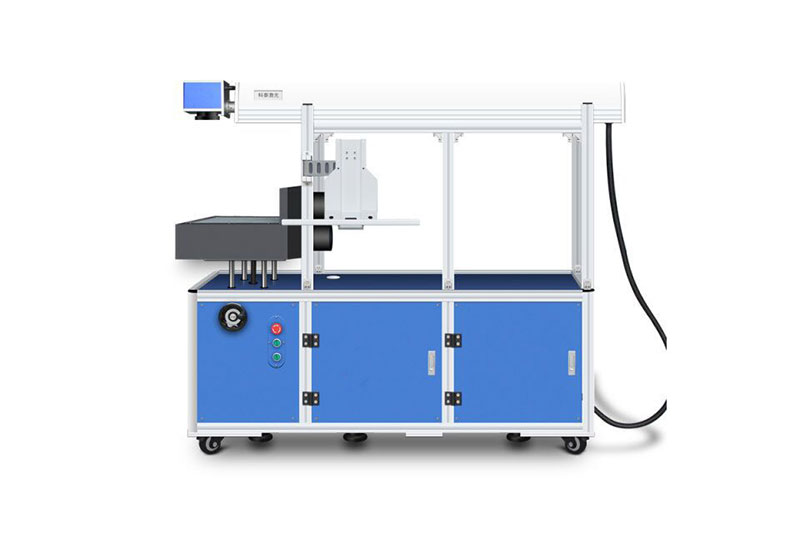
It complements rather than replaces fiber laser marking machines: fiber lasers operate at around 1.06 μm and mainly target metals and some dark plastics, while CO2 lasers focus on non-metals. In applications such as food and beverage packaging, pharmaceutical leaflets, cosmetic tubes, wood and leather products, and PVC pipes, CO2 laser marking machines remain the hard-to-replace mainstay. In typical specifications, these machines deliver 10–30 W output, controllable mark depths of 0.02–0.15 mm, flying marking speeds up to 120 m/min, and RF-excited laser tube lifetimes commonly ranging from 10,000 to 15,000 hours.
According to YH Research, the global CO2 laser marking machine market was about RMB 3.74 billion in 2024 and is expected to approach RMB 5.21 billion by 2031, a CAGR of roughly 4.9%. Its other report, using an "industrial CO2 laser marking machine" scope, puts the 2025 global market at about RMB 4.607 billion, heading toward RMB 6.613 billion by 2032 (5.4%). International firm PW Consulting uses a broader scope (including CO2 marking systems): about USD 651 million in 2025, reaching USD 1.03 billion by 2032, a 6.7% CAGR.
For China, the widely cited 2025 Laser Marking Machine Industry Development Trend Report estimates the overall Chinese laser marking machine market at about RMB 11.187 billion in 2025, of which CO2 laser marking machines account for roughly 25%–30%, equivalent to RMB 2.8–3.4 billion. Another institution expects the Chinese CO2 laser marking machine market to reach about RMB 4.12 billion in 2025, with a CAGR of around 6.7%. Industry-side figures are even more optimistic: according to information released by Qiming Laser in May 2026, the installed base of CO2 laser marking machines in China has surpassed 1.2 million units, with annual new purchases up 18.7% year on year, and customized industry-specific solutions accounting for more than 70% of purchases.
One caveat: different institutions draw different statistical boundaries (whether marking systems are included, and whether the scope is limited to industrial-grade machines), so the numbers should not be compared directly across sources. Trends matter more than the absolute figures.
3.The Product Side: A Week of Dense ActivityRecent vendor moves cluster around two directions: top-tier machine builders are pushing both power and ease of use higher, while control-system vendors are bringing CO2 marking equipment down to the consumer level.
Machine builders are doubling down on power and usability, while control vendors are opening up the consumer market — the form factor of CO2 laser marking equipment is spreading from "workshop-only" to "scenario-based."
4.Three Industry-Wide Shifts: Reliability, Intelligence, ServicesAccording to an industry reference published on Shunqi in August 2026, the CO2 laser equipment market is undergoing three changes:
