"How much does a fiber laser cutting machine cost?" — it's the first question every buyer asks, and the one most often answered vaguely. You'll see broad statements like "tens of thousands of dollars" online, but the real price varies dramatically with power, configuration, brand, table size, and service terms. Quotes for what looks like the same machine can differ by more than 50% between suppliers.
This guide gives you actual USD price ranges for each power class, breaks down what you're really paying for, and shows you which costs you should never cut — and which ones you can.
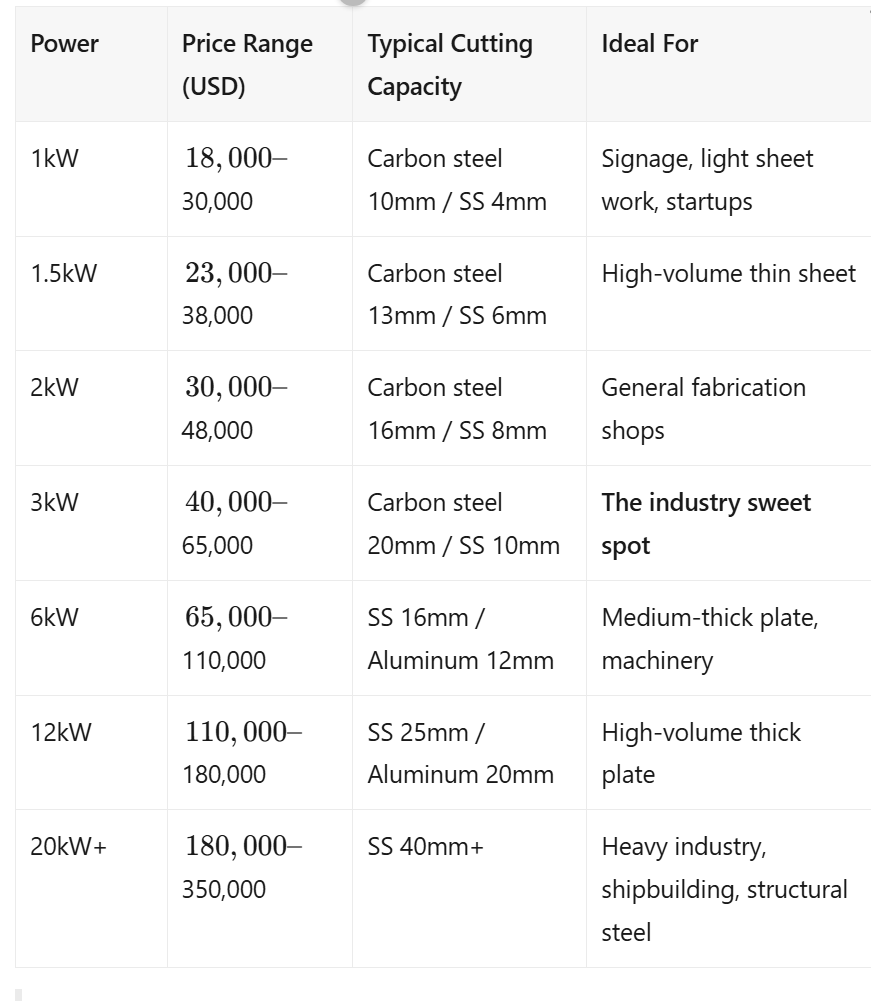
The following are typical 2026 market prices (based on a standard 3015 worktable, Cypcut CNC system, and a mainstream domestic laser source):
The laser source accounts for 30–40% of the machine's cost:
At 3kW, choosing IPG over Raycus typically adds 15,000–25,000 to the machine price.
3,000–10,000.5,000–12,000.5,000–12,000; 6020 and larger formats cost significantly more.Automatic loading/unloading (+15,000–50,000), exchange table (+8,000–20,000), full enclosure (+5,000–15,000), upgraded chillers, and fume extraction all push the total price up quickly.
Quotes that include on-site installation, commissioning, and a 2–3 year laser-source warranty typically run 5–10% higher than "bare machine + 1 year" offers — but they're the better deal over the machine's life.
Budget extra for:
5,000–30,000.2,000–8,000.500–2,000.As a rule of thumb, total landed cost runs 1.1–1.3× the quoted equipment price.

Q1: What's the lowest price for an entry-level fiber laser cutting machine? A: A brand-new 1kW machine with a standard 3015 table starts around $18,000 from a reputable manufacturer. Anything much cheaper is likely an assembled shop-build or a refurbished unit.
Q2: How thick can a 3kW fiber laser cut, and what does it cost? A: A 3kW machine cuts 10mm stainless steel (with nitrogen) and 20mm carbon steel (with oxygen). Price: 40,000–65,000 — the highest-volume power class today.
Q3: How much more does an IPG machine cost vs. Raycus? A: Roughly 30–50% more at the same power. At 6kW, expect 65,000–85,000 with Raycus versus 95,000–130,000 with IPG. Whether it's worth it depends on your processing requirements and budget.
Q4: Are used fiber laser cutting machines worth buying? A: They run 40–60% of new price, but laser-source life, bed precision, and usage history are hard to verify, and they usually come with no warranty. Avoid them unless you have a trusted source and inspection capability.
Q5: Does the price include installation and training? A: For export orders, usually not — it must be agreed separately. Before signing, confirm in writing what's included: installation, commissioning, operator training, spare parts, and manuals.
Fiber laser cutting machines range from about $18,000 for a 1kW entry-level unit to $350,000+ for a 20kW heavy-duty system, with the most popular 3kW class clustered at 40,000–65,000. Remember three things: choose power
