Every sheet metal shop eventually runs the same numbers. Outsourcing a few laser-cut parts is fine, but once order volume picks up, the cutting fee, the round-trip freight and the waiting all turn into cost. That is why more and more small factories are bringing a fiber laser cutter in house. Then comes the hard part: how much power, how big a table, and does open type or enclosed actually matter? This guide walks through the CK series configuration point by point, so you can read a spec sheet and talk to a supplier on equal terms.
Focus Keyword:open type fiber laser cutting machine、fiber laser cutting machine
Fiber laser cutting machines come in three structural families: open type with a single table and no enclosure, exchange-table machines with two tables, and fully enclosed machines. None is universally better. The choice depends on what you cut, how much you cut per day, and how your workshop is laid out.
The CK series is a single-table open-type design. The positioning is straightforward: it suits small factories, first-time laser cutting users, and work that does not involve heavy plate cutting. In practical terms that means:
If that describes you, an open-type machine offers the best value. If your production is continuous 20 mm plate, or you need automatic loading and unmanned operation, look at an exchange-table or enclosed machine instead of forcing this one to do the job.
Anyone can publish a spec sheet. What decides whether the machine still holds tolerance in year three is the bed, the drive train, the beam, the laser source and the cutting head. The CK series configuration reads well along exactly these five lines.
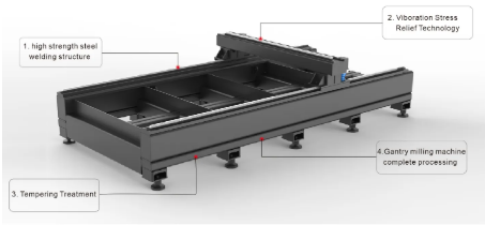
The bed is welded from thick steel plate, the mainstream structure for mid-power machines. Two processes matter: post-weld tempering plus vibration stress relief to release welding stress, and internal reinforcing ribs to raise overall strength and tensile resistance. The published result is a bed machined on a large imported gantry milling machine with running accuracy held within 0.03 mm.
Why does this matter? A welded frame that never had its stress relieved will drift over months. Part dimensions start wandering, the operator keeps tweaking parameters to compensate, and the situation gets worse rather than better. That is usually the root cause when a low-cost machine starts cutting inaccurately after a year or two. A heavy bed also means less vibration and better impact resistance, which is what keeps cutting accuracy stable.
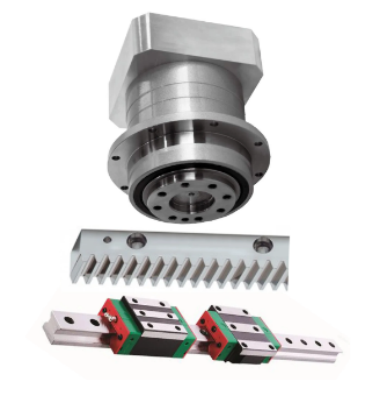
The CK series uses a gantry structure with dual rack-and-pinion transmission and dual servo motors, with 1G acceleration and a no-load speed of 80 m/min on the model table. The real benefit of high acceleration is not top speed but short non-cutting time. A single sheet can carry hundreds of contours, and between each one the head lifts, travels and plunges again. A small difference in acceleration adds up to minutes per sheet, and to real throughput across dozens of sheets a day.
Transmission components are Japanese rack, linear guides and gearboxes, with Taiwan-made linear guides on the rail. Rack-and-pinion rather than ball screws is the right call here: instant transmission accuracy, heavy load capacity and high efficiency suit a long-travel gantry.
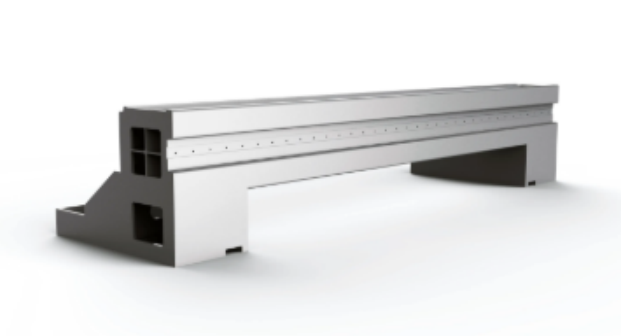
The beam is the most contradictory moving part on the machine, because it has to be stiff and light at the same time. The CK beam is aviation aluminium, extruded on a 4300-ton press to aerospace standards, then heat treated to T6 hardness and finally brushed and finish machined. The result is low weight with high rigidity and good dynamic behaviour. A lighter beam means less inertia load on the servo, faster starts and stops, and corners that do not get rounded off at high cutting speed.
The source is a German IPG unit with wall-plug efficiency above 30 percent. Total machine power consumption runs 30 to 120 kW depending on configuration, so every point of conversion efficiency shows up on the electricity bill. For a shop running two shifts, that saving usually outweighs the discount you might negotiate at purchase.
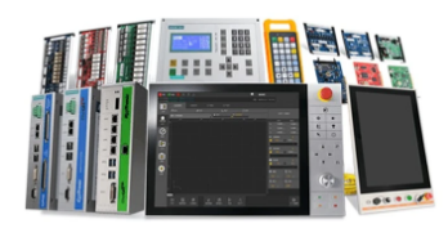
The cutting head is an auto-focus Precitec or Friendness unit paired with the CypCut flat-bed cutting system, a software suite built specifically for laser cutting. Cutting parameters are already integrated in the process library, so switching material or thickness is a matter of calling up a recipe rather than trial cutting. The software also handles two-stage capacitive edge finding with automatic dual-drive drift correction, sharp-corner smoothing, high-speed piercing and fast array scanning.
Two details deserve their own mention. First, the frog-jump function: the head follows a parabolic path between contours and lifts automatically when switching, so it does not have to retract to a full safe height for every contour. Second, machine-level self-diagnostics: automatic diagnosis, fault isolation, fault analysis and data display let an operator clear minor issues without waiting for a service visit, which directly lowers maintenance cost.
The CK series comes in three models. The differences are table size, available power and load capacity.
Table 1 Main specifications of the three CK series models
|
Model |
HN-CK3015 |
HN-CK4020 |
HN-CK6020 |
|
Table size |
1500 x 3000 mm |
2000 x 4000 mm |
2000 x 6000 mm |
|
Laser power |
1000-6000 W |
1000-12000 W |
1000-20000 W |
|
No-load speed |
80 m/min |
80 m/min |
80 m/min |
|
Table load capacity |
3000 kg |
4500 kg |
5000 kg |
|
X/Y positioning accuracy |
+/-0.05 mm/m |
+/-0.05 mm/m |
+/-0.05 mm/m |
|
X/Y repeatability |
+/-0.05 mm |
+/-0.05 mm |
+/-0.05 mm |
The selection logic is simple:
Table 2 General technical specifications of the CK series
|
Item |
Specification |
|
Laser type |
Fiber |
|
Output power |
1000-20000 W, selectable |
|
Cutting format |
6000 x 1500 mm |
|
Max cutting thickness |
Carbon steel 0-45 mm; stainless steel 0-50 mm |
|
Max traverse speed |
0-50 m/min |
|
Cutting accuracy |
<= 0.02 mm |
|
Min kerf width |
0.10 mm |
|
Cooling |
Water cooling |
|
Power supply |
AC 380 V +/-5%, 50 Hz |
|
Power consumption |
30-120 kW |
|
Guide rail type |
Taiwan linear guides |
Cutting accuracy at 0.02 mm or better and a minimum kerf of 0.10 mm determine how small a hole and how sharp a corner you can hold. The electrical side deserves early attention: AC 380 V plus or minus 5 percent at 50 Hz, with power consumption from 30 to 120 kW. The upper end of that range will not run on a standard building supply, so plan the transformer, cabling and workshop layout before the machine arrives.
Note: the general table lists maximum traverse speed as 0-50 m/min while the model table states 80 m/min. Since the two figures differ, confirm the value in the final configuration sheet for your specific model and write it into the technical agreement.
The material envelope is clear: up to 45 mm carbon steel and up to 50 mm stainless steel, as upper limits under matching power and gas configuration. On the application side, fiber laser cutting reaches further than many buyers expect:
There is no single list price for the CK series. A CK3015 with 1000 W and the same machine with 6000 W are two different prices. Choose IPG or a domestic source, Precitec or Friendness, and the number moves again. Any quoted figure without a configuration attached is only a reference.
Four factors drive the quote:
Power level. Higher power raises cutting speed and thickness capability, and raises the price with it.
Cutting range. A larger format needs more bed and beam material, so the price climbs.
Material mix. Different materials bring different cutting difficulty and different requirements on power, assist gas and cutting head.
Brand and build quality. The source of the laser, cutting head, guides and rack makes a visible difference in price.
Send four facts with your inquiry: material, maximum thickness, usual sheet size and sheets per day. A supplier can then quote a real configuration, and you avoid the low-entry-price pattern where every later upgrade is billed separately.
Buy for your material. Match power and configuration to what you cut routinely, not to the maximum thickness in the brochure.
Buy for your format. A table that fits your parts avoids empty floor space, wasted power and wasted capital.
Do not cut corners on brand and build quality. Known components are what keep a production machine stable over its service life.
Check after-sales support before signing. A laser cutter runs for years, and maintenance depends on the supplier being reachable.
A thermal cutting process that uses a high energy density laser beam as the cutting tool. The beam brings the material to ignition point or melts and ablates it, while a high-speed gas jet coaxial with the beam blows the molten material away. CNC laser cutting brings precision, profile cutting, flexibility, one-pass forming and high speed to production work that conventional methods handle poorly.
Mechanically: bed, beam, work table, laser source, cutting head, pressure regulator, water chiller, electrical cabinet and gas supply for oxygen, nitrogen and compressed air. System-wise it combines electrical, mechanical, pneumatic, optical, hydraulic, lubrication and cooling subsystems, making it an integrated machine-light-electric-gas-hydraulic unit. Fabrication involves bending, welding, machining and assembly, and the main transmission is rack-and-pinion because it offers accurate instantaneous motion, heavy load capacity and high efficiency.
Throughput from 1G acceleration and 80 m/min traverse, stability from a 0.03 mm bed and 0.02 mm cutting accuracy, energy savings from an IPG source above 30 percent wall-plug efficiency, and ease of use from an auto-focus head, frog-jump motion, self-diagnostics and professional nesting software.
As a general industry reference: 1000-1500 W handles 1-3 mm sheet in production; 3000 W and above is the usual choice for 4-6 mm; 6000 W for 8 mm and thicker; 12000 W or more for plate beyond 20 mm. Treat these as starting points and have the supplier test cut your actual material before you commit.
Judge by part size and volume. Open type loads easily, takes less floor space and costs less, which suits mixed batches of thin and medium plate. Enclosed machines give better guarding and dust control, and suit high power, long continuous runs and thick plate. The CK series is the former, aimed at small factories and first-time laser users.
On arrival the machine needs foundation levelling, a 380 V supply, the chiller and gas connections, followed by process parameter commissioning by the supplier. Put installation, training and technical support terms in the contract.
The value of the CK series is not one spectacular figure on a spec sheet. It is that the fundamentals of cutting thin and medium plate reliably for years are done properly: a heavy bed that resists distortion, a dual-drive gantry for throughput, an IPG source for energy cost, an auto-focus head for usability and self-diagnostics for low maintenance. For a small shop buying its first machine, the positioning is clear.
If you are evaluating an open-type fiber laser cutter, send us your material, thickness and usual sheet size. Honeybee CNC, Honey (Guangzhou) Equipment Co., Ltd., will quote a configuration built around your actual work rather than an attention-grabbing entry price
