This guide elaborates on the complete selection logic of tube‑cutting machines from six dimensions: processing requirements, core hardware, software systems, automation configurations, on‑site verification and pitfalls to avoid.
1. Clarify Basic Processing Requirements (First Step for Model Selection)
Before contacting manufacturers, sort out the following 5 key pieces of information to avoid being oversold high‑power or over‑sized models.
- Tube types: Mainly process round, square or rectangular tubes, or special‑shaped section steel including angle steel, channel steel and I‑beam; material type: carbon steel, stainless steel or aluminum alloy.
- Tube specifications: Maximum tube diameter / square‑tube side length, wall thickness, raw tube length (common lengths: 6 m, 9 m, 12 m).
- Process requirements: Simple cutting‑off only, or requirements for intersecting‑line hole cutting, angle cutting, bevel cutting and hollow patterns; requirements for burr‑free cuts and welding suitability.
- Production volume: High proportion of small‑batch orders or mass standardized production; frequency of tube‑specification change‑over.
- Workshop conditions: Workshop length & width, floor load capacity, power supply capacity and air‑source conditions.
Misconception warning: Do not blindly pursue "bigger is better". If you mostly process small‑diameter tubes, an oversized chuck will reduce rotation speed and lower processing efficiency. Rare large‑tube jobs can be outsourced.
2. Match Laser Power According to Actual Needs
Laser power determines the maximum cuttable wall thickness. Higher power is not always better, as excessive power raises both procurement cost and power consumption.
| Power Range |
Reference Application Scenarios |
| 1500‑2000 W |
Thin‑wall tubes for furniture, guardrails and iron art; Carbon steel ≤ 4 mm, Stainless steel ≤ 3 mm |
| 3000‑6000 W |
Mainstream general‑purpose model for sheet‑metal shops and engineering‑machinery parts; Carbon steel 8‑12 mm, Stainless steel 5‑8 mm |
| 6000‑12000 W |
Heavy‑duty industries for thick‑wall pipelines, heavy steel structures and thick section steel |
Note: Thickness values in specification sheets represent
limit cutting capacity. For stable mass production, select for a wall thickness 1‑2 mm below the rated limit to guarantee cutting speed and edge quality. Over‑powered machines for thin tubes will cause over‑burning and corner melting.
3. Check Core Hardware for Long‑term Machine Stability
3.1 Chuck System (Most Critical Component for Tube Cutters)
3.2 Machine Bed & Frame
Rotating tubes generate continuous torsional force. Light‑weight beds suffer accuracy drift over long‑term operation. Choose heavy‑duty stress‑relieved welded beds and side‑mount structures for high rigidity and anti‑vibration performance during high‑speed rotation. Match bed length with raw tube length (6 m / 9 m / 12 m).
3.3 Cutting Head, Servo and Electrical Components
- Cutting head: Auto‑focus cutting heads are recommended. They adapt focal position automatically for tube corners and wall‑thickness variations for consistent cutting quality.
- Servo motors, guide rails and racks: Choose well‑known brands to ensure responsive rotation and feeding motion.
- Electrical components & chiller: Adopt mature branded low‑voltage electrical parts and chillers to lower failure rates.
4. Control System & Nesting Software Determine Real‑world Productivity
Many buyers focus only on hardware and overlook software, resulting in poor production efficiency.
- CNC Control System: Adopt proven bus‑based tube‑cutting dedicated systems supporting intersecting‑line cutting, bevel cutting and section‑steel programming, with easy operation and convenient drawing import.
- Specialized Tube‑nesting Software (Highly Important): Basic systems only support simple programming. For mass production, professional tube‑nesting software is required to enable mixed‑part nesting and common‑line cutting within one raw tube. This minimizes remnant material and saves raw‑material cost. Section‑steel processing (angle steel, channel steel) imposes higher requirements on nesting‑software functionality.
Reminder: Confirm whether nesting software is included in the quotation. Some manufacturers offer low‑priced hardware but charge extra high fees for software.
5. Automation Options for Loading & Unloading
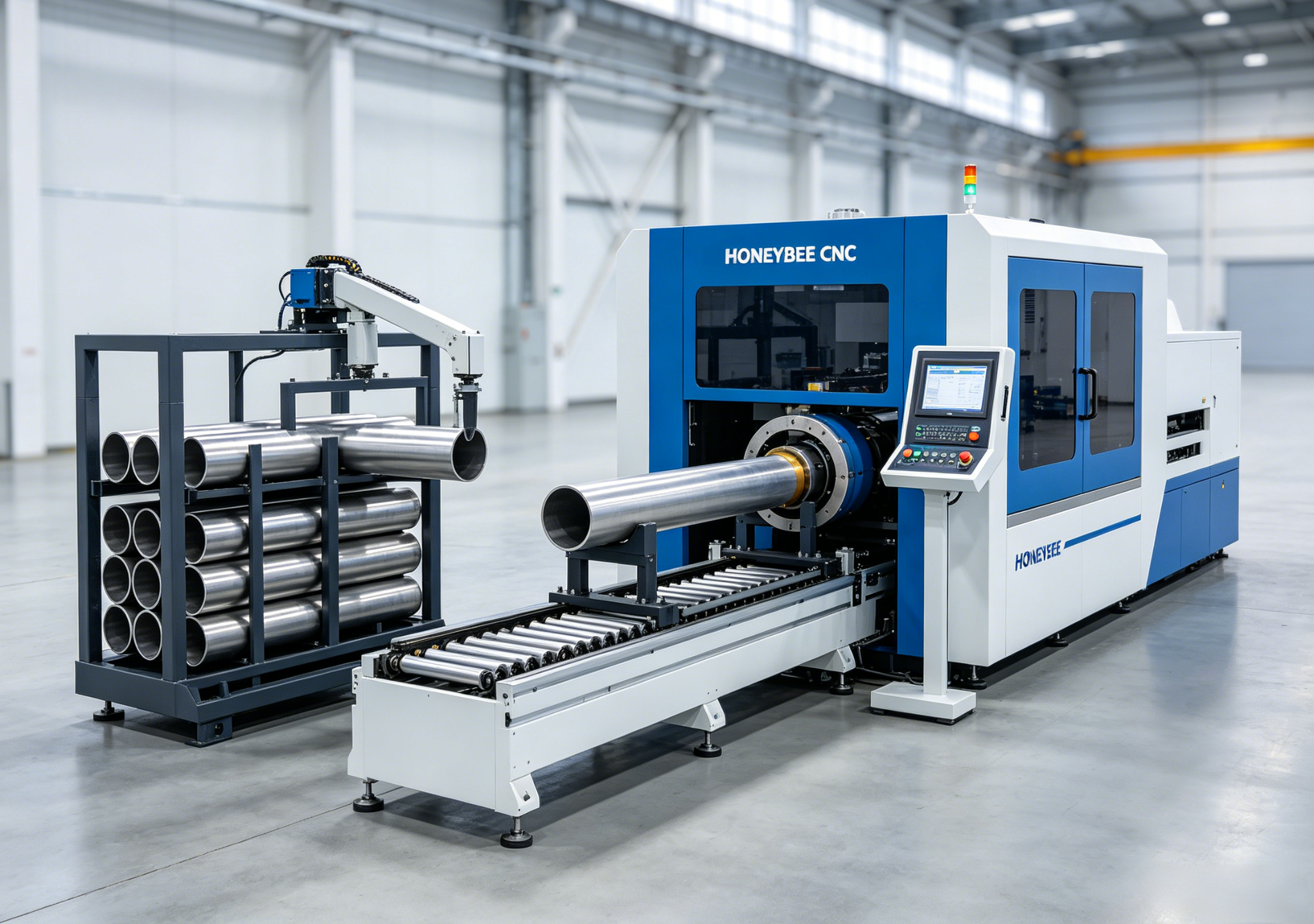
Automation directly impacts labor cost. Select based on your specification‑change frequency.
- Manual loading: For limited‑budget projects with frequent specification changes and small‑batch production. Suitable for tubes under 6 m, lowest investment.
- Semi‑automatic loading: Operator places single tube manually and the machine feeds automatically. Versatile and cost‑effective for most fabricators.
- Fully‑automatic loading rack: Supports automatic bundle de‑bundling, material separation and continuous feeding. Ideal for mass production with fixed tube specifications. Drawback: long setup time for frequent specification changes, limiting its advantages.
Tip: For heavy tubes, select models with supporting rest structures to prevent tube sagging and vibration, securing cutting accuracy.
6. On‑site Cutting Test & Supplier After‑sales Evaluation
- Bring your samples for trial cutting: Take your most‑frequently‑processed tube samples for on‑site trial cutting at the manufacturer’s facility. Inspect cutting quality, hole‑making performance, corner condition and burr level. Observe stability during continuous running. Do not rely solely on brochure specifications.
- Evaluate after‑sales support: Check for local service teams and guaranteed response time. Tube‑cutting machines are structurally more complex than flat‑sheet laser cutters and harder to repair. Reliable after‑sales service guarantees continuous production.
- For overseas export projects: Confirm CE safety compliance, complete English‑language documentation and spare‑parts lists to satisfy overseas application requirements.
7. Common Selection Pitfalls to Avoid
- ❌ Compare only power and price while ignoring chuck load capacity and bed rigidity, leading to accuracy drift after half‑year operation.
- ❌ Blindly select oversized chucks and high power for small‑tube jobs, resulting in low efficiency and wasted procurement & electricity cost.
- ❌ Neglect nesting software, causing large tube remnant loss and high raw‑material waste.
- ❌ Prioritize hardware over after‑sales service. Failures of chucks and rotary assemblies cause long downtimes and order delays.
- ❌ Confuse limit cutting parameters with mass‑production parameters. Limit thickness is for occasional tests and shall not be used as regular production standard.
8. Quick Selection Summary
- Small‑scale iron art & furniture production: ≤ 3000 W, dual‑chuck, 6‑m machine, semi‑automatic loading.
- General‑purpose tube‑processing workshops: 3000‑6000 W, dual‑ or three‑chuck configuration, equipped with nesting software.
- Heavy‑duty, long‑tube & mass section‑steel processing: 6‑12 m bed, three‑chuck heavy‑duty model, fully‑automatic loading plus professional section‑steel nesting software.
Conclusion: A well‑suited laser tube cutter is not the model with the most impressive spec‑sheet figures. It should fully match your order mix and deliver
comprehensive benefits balancing procurement cost, power consumption, labor input and raw‑material utilization.


